
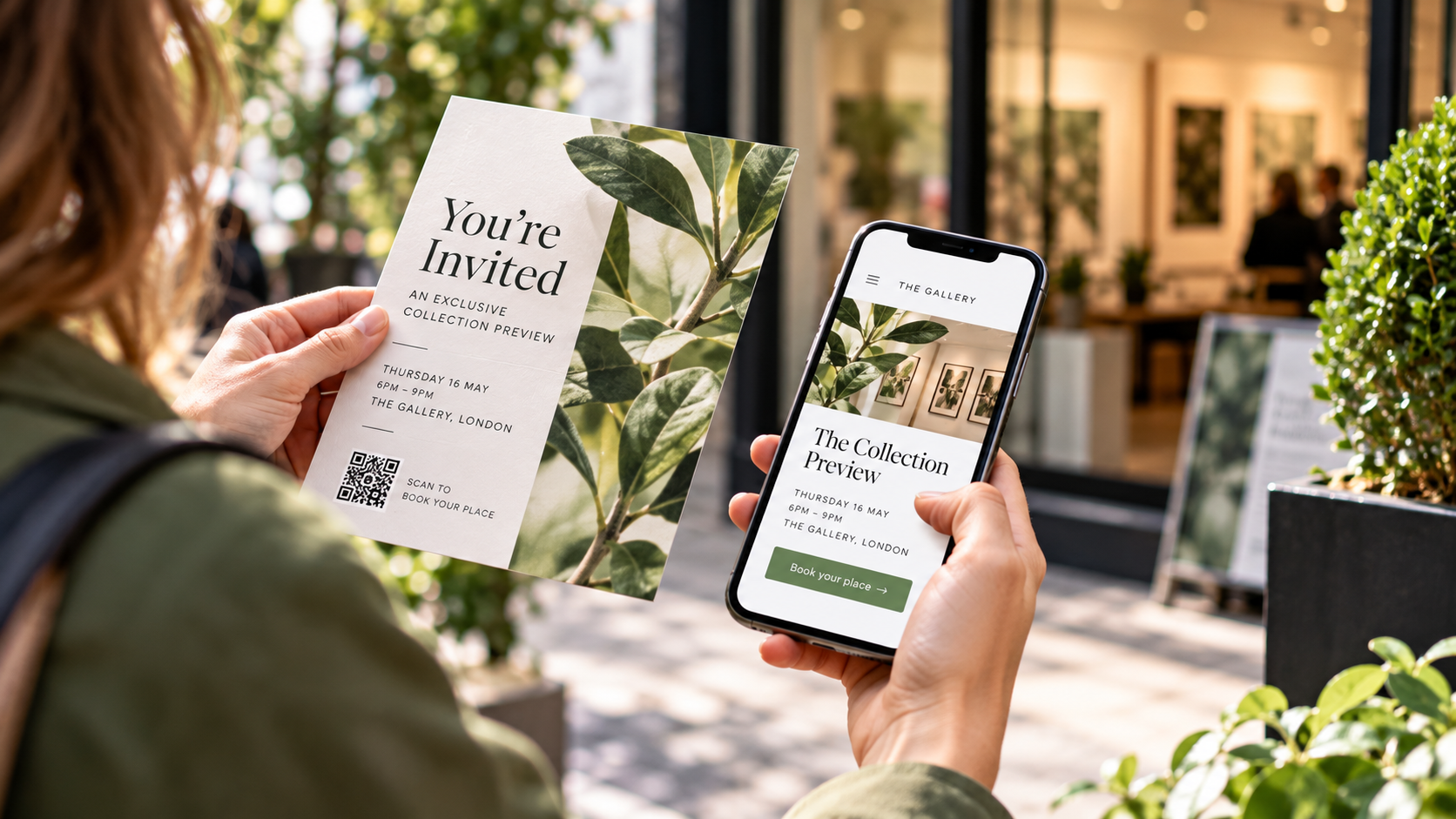
After all, your customers don’t necessarily separate their experiences with your business into different marketing channels. They might receive a beautifully printed invitation, visit your website to find out more, and then make a purchase after seeing a follow-up email.
To them, it’s all one experience with your brand.
The interesting question, then, isn’t which channel is better. It’s whether the different parts of that experience are working together as well as they could.
Print and digital each have their strengths, and I think it’s important to recognise those differences rather than expect one to do everything.
Digital is particularly useful when you need to share information quickly, respond to customer behaviour, update content or make it easy for someone to take an immediate action.
Print offers something different. It gives people a physical object they can hold, browse, keep or return to. Depending on its purpose, that might be a catalogue someone enjoys looking through, an invitation that makes an event feel special or a piece of direct mail that prompts them to investigate an offer.
Neither approach automatically delivers better results. What matters is understanding the job you’re asking each to do.
And when you start thinking about those jobs together, rather than treating each channel as a separate activity, you can make more informed decisions about where print adds value.
One of the most interesting things about print is that its influence doesn’t necessarily end when someone puts it down. In fact, it might only be the beginning of their next interaction with your business.
Recent research from JICMAIL provides some useful evidence of this. Its Q1 2026 findings showed that 9.4% of mail items prompted a website visit, while 56% of purchases driven by mail were completed online.
That’s a useful reminder that a digital purchase doesn’t always begin with a digital interaction. But there’s an important distinction here. Those figures demonstrate how mail can influence online behaviour; they don’t mean that every printed campaign will produce the same response.
The opportunity lies in understanding how you want someone to move from one interaction to the next, and then making that journey feel natural.
Here’s something I think businesses can easily overlook: putting a QR code on a printed piece doesn’t automatically create a joined-up customer experience.
Imagine receiving a beautifully produced invitation to an exclusive event. Everything about it feels considered, from the paper and finishing to the way the information is presented. You scan the QR code to book your place, only to arrive at a generic homepage where you then have to go on the hunt for the event yourself. The print’s done its job by encouraging you to act, however the connection between the two experiences has let you down.
Now imagine that same invitation taking you directly to a dedicated booking page, with the same visual identity, a clear next step, and information that builds naturally on what you’ve already read. It’s a relatively small difference, but it changes the experience completely.
And from a print-production perspective, this is where the details matter. Is the QR code large enough to scan comfortably? Does its position make sense? Have you tested it on the finished material, rather than assuming that because it works on a screen, it will work equally well in print?
A digital connection is only useful if the physical piece makes it easy for someone to use it.
There are plenty of opportunities to connect the two channels without making the process unnecessarily complicated. This might look like a:
In each case, the important decision isn’t simply to include a digital element. It’s to understand what the printed piece needs to achieve before the customer moves on.
Sometimes that means giving them a reason to act immediately. At other times, the value of print is they can spend time with it and come back to the digital element when they’re ready.
Something I remind people time and again is that the most useful print decisions usually happen before anyone starts discussing paper or finishing.
For example:
These are all examples of our Print Wisdom® in practice.
It’s about understanding what you want the finished print to contribute, identifying the decisions that will support that objective, and making sure production doesn’t become disconnected from the wider purpose.
Because a beautifully produced piece of print can still miss an opportunity if no one’s considered what the customer’s supposed to do next.
For me, the most useful conversation isn’t about choosing between print and digital. It’s about understanding where print can make a valuable contribution and then producing it in a way that supports everything else you’re doing.
That doesn’t mean every campaign needs both channels. Sometimes one is perfectly capable of doing the job on its own. But where print and digital marketing have a genuine reason to work together, the decisions you make about your print can help create a more connected and effective customer experience.
If you’re planning a campaign and would like to explore how print could support your wider marketing activity, get in touch – we’d love to support you.
Enjoyed this blog and want more ideas and inspiration? Visit our Print We Love page where we regularly share more knowledge and expertise on print marketing and production.

Gill Robinson
19th October 2026




 by PAGE