
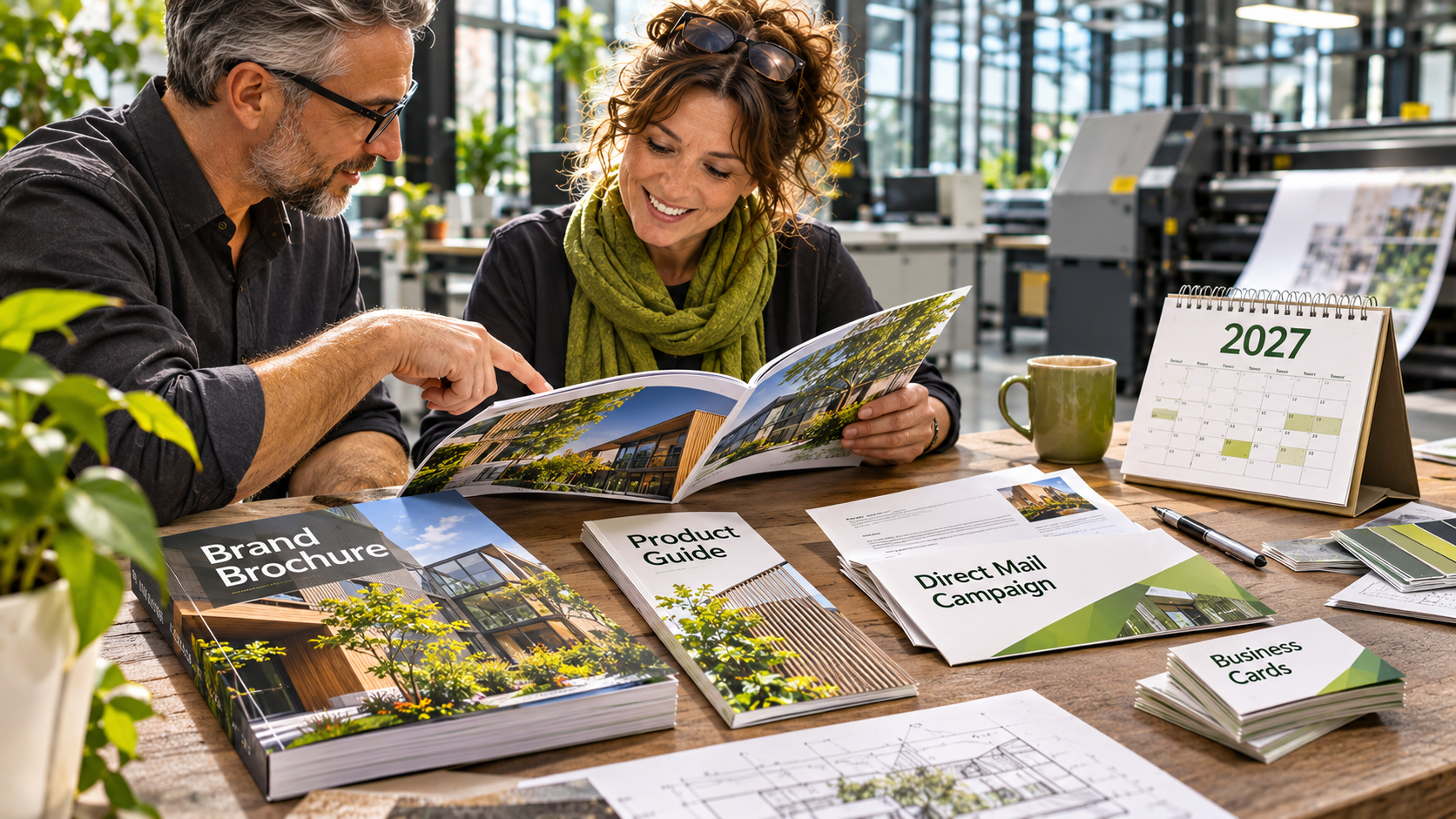
For many organisations, print is still something that gets considered when a particular job comes along. A brochure needs updating, an event is approaching, or someone suddenly realises they’re running low on marketing collateral.
There’s nothing unusual about that. Businesses are busy, priorities change, and sometimes the need for a quick turnaround is unavoidable. However, I think we have a real opportunity here to look at print planning differently. Particularly if your business regularly produces printed materials.
You see, the value of a good print decision doesn’t necessarily end when the job is delivered. In fact, it could be the beginning of a much smarter way of managing your print.
Imagine you’ve invested time in producing a beautiful new company brochure. You’ve explored paper options, agreed the right finish, tested colours, and settled on a specification that works brilliantly for your brand. Then, six months later, you need another publication – perhaps it’s a product guide or a brochure for a different audience.
Do you build on what you’ve already learned, or does the whole conversation start again?
This is something worth thinking about because when businesses treat print jobs as completely separate projects, they can end up revisiting decisions they’ve already made.
Different teams may commission similar materials with different specifications. Suppliers might be asked to quote without knowing what has worked previously. And useful knowledge about production, costs, and materials can easily disappear once a job is completed.
The individual projects might all turn out perfectly well, but there’s a missed opportunity to make the next one easier.
One of the advantages of looking at your print requirements together is that you begin to see connections that aren’t always obvious when you’re focused on the next deadline.
Perhaps several departments regularly produce brochures, yet each uses a slightly different format. Standardising certain elements could simplify production and make future ordering more straightforward, without restricting the design of individual pieces.
Or maybe your business has a busy events calendar, with recurring requirements for signage, programmes, invitations, and promotional materials. Knowing what’s coming gives you more opportunity to coordinate production and avoid unnecessary last-minute decisions.
Even something as straightforward as keeping a record of successful specifications can be valuable. The paper that worked beautifully for your annual report might also be appropriate for another publication, saving time spent researching and sampling alternatives.
Of course, you don’t need to standardise everything, because sometimes a particular campaign deserves a completely different approach. The point here isn’t to make every piece of print the same. It’s to stop making every print decision as though it’s the first time you’ve made it.
When you invest in good print production, you’re not simply paying for the finished materials. You’re also developing an understanding of what works for your business. You learn which formats are practical, which materials suit your brand, what quantities are realistic, and how much time is required for particular production processes.
There’s a useful parallel here with wider marketing thinking. In an article for the Marketing Association, Phil Mecredy explores why businesses benefit from building on what’s already working, rather than continually reinventing their approach.
And we can apply the same principle to print production.
You don’t necessarily need a complicated system. A clear record of approved specifications, previous quantities, production timings, and lessons learned can give you a stronger starting point next time.
When you consider that information across your wider print requirements, you have an opportunity to improve consistency, reduce duplication, and make better use of your budget.
Now, I’m certainly not suggesting you already need to know every piece of print your business will need next year! Marketing plans evolve, new opportunities appear, and priorities can change quite quickly.
However, there are usually some things you can anticipate.
You might already know which exhibitions or events you’re attending, when your seasonal campaigns are likely to run, or which of your publications need updating annually. You may also know that certain materials are ordered regularly, even if the exact quantities aren’t clear yet.
Looking at all those requirements together can help you identify where early decisions would be useful.
For example, if several printed pieces are likely to use the same materials, it’s worth exploring whether you could coordinate their specifications. Or if you have a particularly busy period approaching, you can start considering production capacity and lead times before deadlines become uncomfortable. And if a brochure is likely to need frequent updates, that may influence how you specify and produce it in the first place.
Good planning should give you more flexibility, not less.
It’s about making the decisions you can make now, so you’re better prepared for the decisions you’ll need to make later.
This is where I believe there’s a real difference between simply placing a print order and having an ongoing relationship with someone who understands your business.
When we work with clients over time, we get to know their print requirements, the challenges they’ve encountered, and the production choices that have worked well for them. That means we can bring useful knowledge into our next conversation rather than starting with a blank sheet of paper every time.
We might see an opportunity to simplify a specification, coordinate several upcoming jobs or revisit a material choice because the way a publication is being used has changed. Sometimes it’s about spotting a potential problem early, while at other times, it’s recognising that a decision made for one project could benefit several more.
For me, that’s an important part of our Print Wisdom®.
We’re looking at the purpose behind your print, the practical decisions involved in producing it, and how those decisions can support your business over time. And because we’re considering the bigger picture, we can help you make informed choices about individual projects without losing sight of what you’ve already invested in.
As you look ahead to the coming year and start considering what print you’ll need, also think about what you’ve learned from the print you’ve already produced.
A more considered approach to print planning doesn’t mean adding another complicated process to your business. It means making better use of the decisions, experience, and resources you already have.
And that’s something that will continue delivering value to your organisation long after 2027.
If you’d like to explore how a more joined-up approach could help your business get more from its print, get in touch – we’d love to support you.
Enjoyed this blog and want more ideas and inspiration? Visit our Print We Love page where we regularly share more knowledge and expertise on print marketing and production.

Gill Robinson
19th November 2026



 by PAGE