
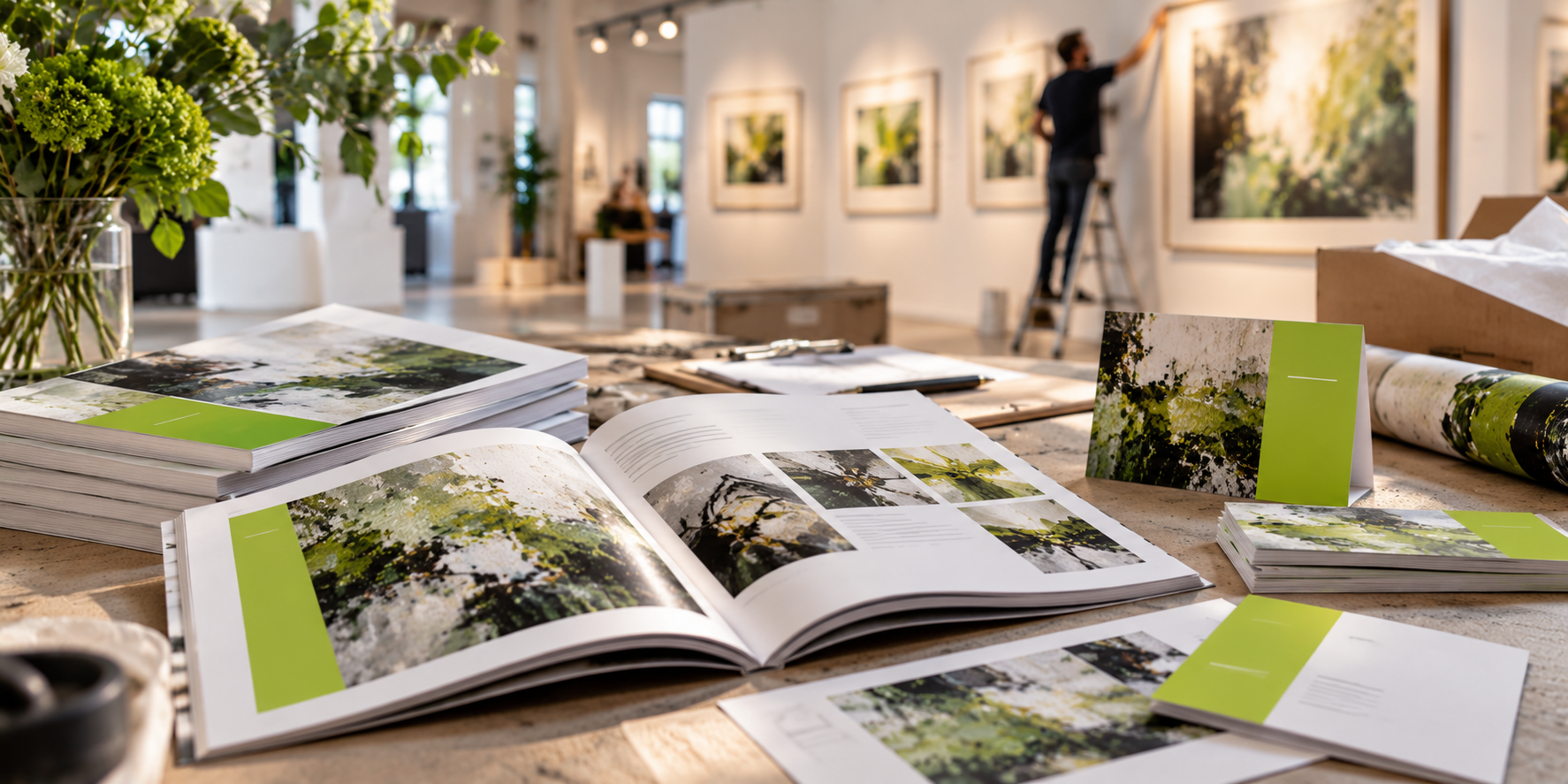
And if there’s one thing that’s certain about an exhibition opening date it’s this: it isn’t going to move because the catalogue is running late!
Over the years, I’ve learned that exhibition print rarely becomes stressful because of one big decision. More often, it’s the accumulation of lots of small decisions that have been left too late.
So, how do we make the whole process feel calmer and more under control?
One of the best things you can do is get clear about your print requirements early – ideally while there’s still plenty of breathing room.
These questions may sound straightforward, but the answers influence what happens next.
A catalogue that needs to be available for the opening has a very different production journey from invitations that need to land several weeks beforehand, while signage and wall cards need to work around the installation itself.
In this article the Southbank Centre offers a glimpse behind the scenes at the Hayward Gallery, where work on an exhibition catalogue begins as soon as an exhibition is confirmed. That early planning gives the gallery time to bring together artists, curators, designers, writers, reproduction specialists, printers and distributors. It serves as a useful reminder of just how many moving parts can sit behind one finished publication.
The earlier we understand all of the moving parts, the more opportunity we have to make good print decisions rather than rushed ones.
A visitor may never consciously think about the relationship between the catalogue in their hands, the invitation they received, and the information sitting beside an artwork on the wall. But the truth is they still experience them together.
That’s why consistency matters. Colour reproduction, typography, materials, finishes and production quality all contribute to how the exhibition presents itself and, particularly where artwork is being reproduced, some of those decisions deserve careful attention.
This isn’t about making every printed item identical – different pieces have different jobs to do. It’s about protecting your creative intent and making sure the print supports your work rather than distracting from it.
Sometimes that means testing an idea before committing to it. And sometimes it means suggesting a different material or production process because experience tells us the original specification may not give the result everyone is expecting.
For me, good print production isn’t about saying yes to every specification. It’s about understanding what you’re trying to achieve and helping you find the best way to achieve it.
This is where we can help the pressure to really lift.
You might have one supplier producing a catalogue, another creating signage, and somebody else handling a specialist finish. Each supplier can do their individual job perfectly well, but if nobody’s looking across the whole project, it’s surprisingly easy for gaps to appear between them.
Someone needs to know what depends on what, where the potential production risks are, what needs to be approved and when, and whether one late decision is going to affect something further down the line.
This is our Print Wisdom® in practice.
It’s about looking beyond the individual catalogue, invitation or piece of signage and seeing the complete print-production picture around your exhibition. Our job is to handle that part of the exhibition with you, bringing the right specialists together and keeping those interconnected print decisions moving in the right order.
Because when you’re preparing to put your work in front of an audience, you really shouldn’t also be wondering whether someone has remembered to chase the wall cards.
One of the things experience teaches you is that an exhibition deadline isn’t simply the date the print needs to arrive.
The real deadline is the point at which it can arrive without creating pressure for everyone else.
If signage arrives just as installation is finishing, it may technically be on time, but it hasn’t left much room to deal with any unexpected problems. The same applies to catalogues, brochures and anything else that needs checking, distributing or positioning before visitors arrive.
We can also plan for different destinations from the outset. Perhaps some catalogues need to go directly to the gallery while others are destined for press contacts or VIPs. Thinking about that early means delivery becomes part of the production plan rather than another last-minute job.
By the time an exhibition opens, your print should be one of the things you’re no longer thinking about.
That’s what our joined-up approach to art exhibition printing can give you: not simply beautifully produced materials delivered on time, but the confidence that someone experienced has been holding all those production threads together while you’ve been concentrating on the exhibition itself.
So, if you’re an artist or gallery planning an exhibition and would like some expert assistance with the print surrounding it, get in touch – we’d love to support you.
Enjoyed this blog and want more ideas and inspiration? Visit our Print We Love page where we regularly share more knowledge and expertise on print marketing and production.

Gill Robinson
24th September 2026




 by PAGE